
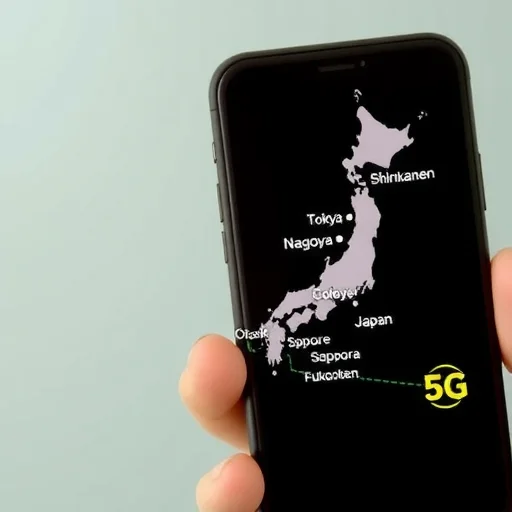
Traveling to Japan? Here’s What You Need to Know About 5G eSIMs
If you’re planning a trip to Japan—whether it’s exploring the neon streets of Tokyo, visiting the historic temples of Kyoto, or hiking in the Japanese Alps—staying connected is essential. A 5G eSIM offers the convenience of a digital SIM combined with the fastest available mobile network speeds. Japan is one of the world’s leaders in 5G technology, with extensive coverage in cities and growing availability in rural areas. This guide explains everything you need to know about using a 5G eSIM in Japan, including which networks offer the best coverage, where to buy one, and how to choose the right plan for your trip.
Japan has three major mobile network operators: NTT Docomo, au (KDDI), and SoftBank. NTT Docomo has the most extensive overall coverage, particularly in rural areas, mountains, and along the Shinkansen (bullet train) routes. au also offers strong coverage, with excellent performance in cities and suburban areas. SoftBank is a solid choice in urban centers but can be less reliable in remote regions. When choosing a 5G eSIM for Japan, the network partner is critical, especially if you plan to travel outside major cities. For the widest coverage, especially in rural Japan, an eSIM using NTT Docomo’s network is your best bet.
You have two main options for getting a 5G eSIM in Japan: global eSIM providers that offer Japanese plans, and local Japanese carrier eSIMs.
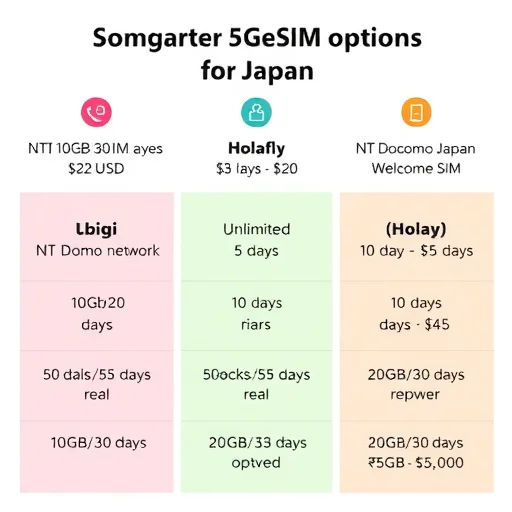
**Global eSIM providers** like Airalo, Nomad, Holafly, and Ubigi offer eSIM plans for Japan. These are convenient because you can buy and install them before you leave home. Many of these plans now include 5G access where available. For example:
**Ubigi** is particularly popular for Japan because it uses NTT Docomo’s network exclusively. Ubigi offers 5G plans with data allowances from 1GB to 10GB, and their speeds and coverage are excellent.
**Airalo** offers Japan plans that typically use SoftBank or NTT Docomo. Their plans are data‑only and come in various data allowances.
**Nomad** similarly offers Japan eSIMs, often with fixed‑total or daily‑cap options. Their plans usually use NTT Docomo or SoftBank.
**Holafly** specializes in unlimited data plans. Their Japan eSIM includes unlimited data with 5G on the NTT Docomo network—ideal for heavy users who want to stream and work remotely without worrying about data caps.
**Local Japanese carrier eSIMs** are another excellent option. NTT Docomo, au, and SoftBank all offer prepaid eSIMs that you can purchase online or at their shops upon arrival. These often come with a local Japanese phone number, unlimited calls and texts within Japan, and generous data allowances. For example:
**NTT Docomo** offers the “Japan Welcome SIM” prepaid eSIM, which includes 5G, a local number, and typically 10–20GB of data for around ¥3,000–¥5,000 (about $20–$35) for 15–30 days.
**au (KDDI)** offers similar prepaid eSIMs with 5G, often through their “au Travel” brand.
**SoftBank** offers prepaid eSIMs for travelers, available at airport kiosks and online.
Now, let’s talk about 5G coverage in Japan. Japan’s 5G rollout is extensive. In major cities like Tokyo, Osaka, Nagoya, Sapporo, Fukuoka, and Yokohama, you’ll find excellent 5G coverage from all carriers. Along the Shinkansen lines connecting these cities, you’ll also have good 5G coverage. In smaller cities, towns, and rural areas—including popular tourist destinations like Hakone, Kamakura, Nikko, and the Japanese Alps—NTT Docomo has the most reliable 5G coverage. au and SoftBank are also strong in many areas, but Docomo has the edge in remote regions. If your itinerary includes rural Japan, hiking, or visiting off‑the‑beaten‑path locations, a Docomo‑based eSIM (Ubigi, Holafly, or NTT Docomo direct) is highly recommended.
Let’s look at a few scenarios to help you decide.
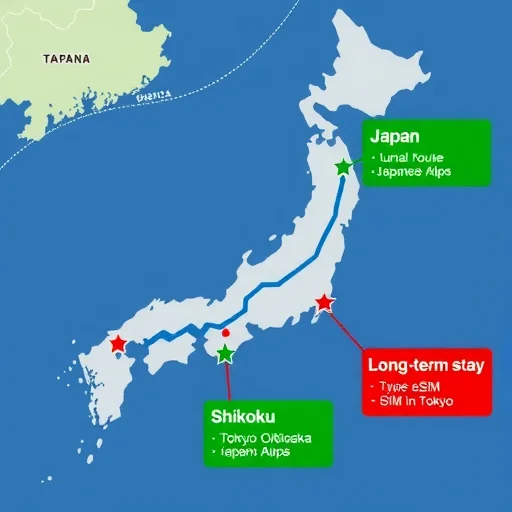
**Scenario 1: City‑centric trip.** You’re spending a week in Tokyo and Osaka, with maybe a day trip to Kyoto. You’ll be using maps, social media, and video calls. A 5G eSIM from any major provider will give you excellent speeds. A 5GB or 10GB plan from Ubigi, Airalo, or Nomad is likely plenty. If you want the simplicity of unlimited data, Holafly’s unlimited plan is a good fit.
**Scenario 2: Exploring rural Japan.** You’re traveling to Hakone, the Japanese Alps, and rural Shikoku. You need coverage that extends beyond the cities. An NTT Docomo‑based eSIM (Ubigi, Holafly, or NTT Docomo direct) is your best choice for consistent 5G in towns and reliable 4G in between. A 10GB or 20GB plan will serve you well.
**Scenario 3: Extended stay.** You’re staying in Japan for a month, working remotely. You need a local number for calls, a large data allowance, and reliable 5G. The NTT Docomo Japan Welcome SIM offers 20GB for 30 days, and you can top up. Having a local Japanese number is useful for restaurant reservations, delivery apps, and local services.
Now, let’s discuss device compatibility. To use a 5G eSIM in Japan, your phone must support both eSIM and the 5G bands used in Japan. Japanese 5G uses bands like n77, n78, n79. Most modern international iPhones (12 and newer), Google Pixels (5 and newer), and Samsung Galaxy flagships (S20 and newer) support these bands. However, some phones from other regions may have limited compatibility. Ubigi and other providers often have a compatibility check on their websites. It’s worth confirming before you travel.
Cost is another factor. Global eSIM providers offer competitive pricing, especially for short trips. A 10GB Ubigi Japan plan costs around $22 USD for 30 days. The NTT Docomo Japan Welcome SIM gives you 20GB for around ¥5,000 (about $35) for 30 days, which is a better value per GB for longer stays. For trips longer than two weeks, a local prepaid eSIM often gives you more data for your money.
One more consideration: if you’re traveling beyond Japan to other countries, a Japan‑specific eSIM won’t work outside the country. For multi‑country trips in Asia, consider a regional eSIM (e.g., “Asia” or “Asia Pacific”) that covers Japan and other destinations. However, these regional plans may not offer 5G in all countries, so check the details.
I recently helped a friend plan a two‑week trip to Japan that included Tokyo, Hakone, Kyoto, and the Japanese Alps. She opted for Ubigi’s 10GB 5G eSIM. She bought it online before departure, installed it, and it activated when she landed. In Tokyo and Kyoto, she had 5G everywhere. In Hakone and the Alps, she had reliable 4G on Docomo’s network, which was sufficient for maps, navigation, and staying in touch. She used about 8GB over the two weeks and was very happy with the coverage.
Another friend, who was only in Tokyo for a long weekend, used a 5GB Airalo eSIM. He installed it before departure, used it for maps, social media, and WhatsApp calls, and never had any issues. He paid about $15 USD and had data the moment he landed.
If you’re a heavy data user—streaming video, joining video calls, tethering—consider Holafly’s unlimited plan or a local plan with a large data allowance. If you’re a light user, a small fixed‑total plan will suffice.
In summary, a 5G eSIM is an excellent choice for Japan. For the best coverage, especially if you’re traveling outside major cities, choose an eSIM that uses NTT Docomo’s network. Ubigi is a top choice for Docomo‑based eSIMs, with easy installation and reliable performance. For short trips, global providers like Airalo or Nomad offer convenience and competitive pricing. For longer stays or if you need a local number, the NTT Docomo Japan Welcome SIM provides great value. With a 5G‑compatible phone, you’ll enjoy fast speeds in cities and reliable connectivity across the country. For Japan, a 5G eSIM offers fast speeds in cities and growing rural coverage. NTT Docomo provides the most extensive 5G coverage nationwide, especially in rural areas. Choose Ubigi for a convenient, Docomo‑based eSIM; Airalo or Nomad for short urban trips; Holafly for unlimited data; or the NTT Docomo Japan Welcome SIM for a local number and longer stays.
JapanTravelConnectivityFINISHED

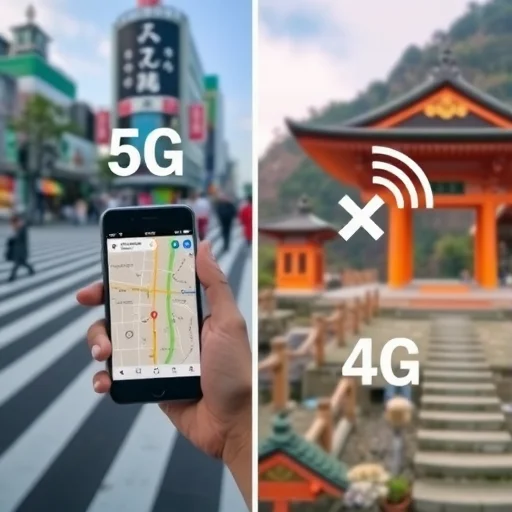
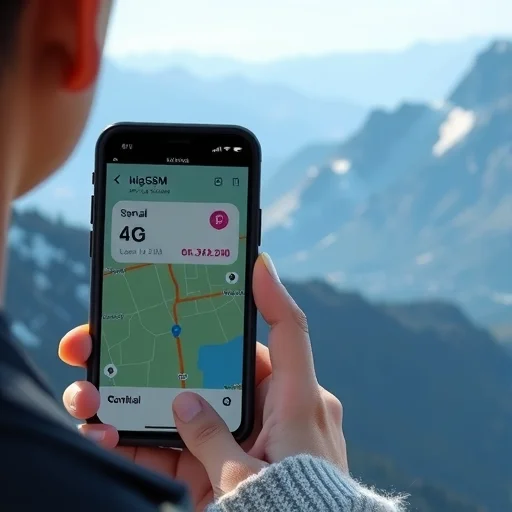
Important tip: If you’re going to rural Japan, make sure your eSIM uses NTT Docomo. I used a SoftBank-based eSIM and lost signal in the mountains. Switched to Ubigi (Docomo) and it was night and day.
I stuck to Tokyo and Osaka and used a 5GB Airalo eSIM. Worked perfectly, 5G was fast everywhere. Perfect for a short urban trip.
Used Ubigi for 2 weeks in Japan—Tokyo, Kyoto, Hakone, and the Japanese Alps. Had 5G in cities, reliable 4G in rural areas. Installation was easy before I left. 10GB was plenty. Highly recommend Ubigi for Japan.
I bought an NTT Docomo Japan Welcome SIM at the airport. Got 20GB for ¥5,000. The local number was handy for restaurant reservations. Great value for a longer stay.
I’m a heavy user—streaming and video calls—so I used Holafly’s unlimited Japan eSIM. 5G in Tokyo was blazing fast. No data worries. Worth the price for peace of mind.