
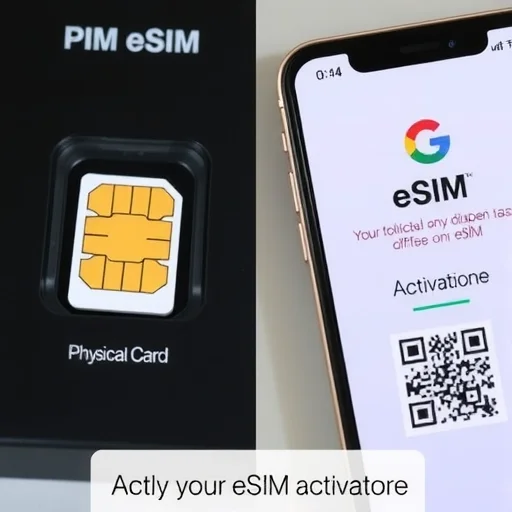
If you’ve recently bought a new smartphone, you may have already noticed a shift: more and more phones are launching without a physical SIM card tray, and carriers are increasingly pushing eSIM activation. This has left many people wondering—should I stick with the traditional physical SIM card I’ve used for years, or should I switch to eSIM? The answer isn’t one-size-fits-all. Your best choice depends entirely on how you use your phone, how often you travel, and what kind of flexibility you need. In this guide, I’ll break down how each option works, their real-world pros and cons, and help you decide which is right for your situation. Let’s start with the basics.
A physical SIM card is the small plastic card you’ve inserted into phones for decades. It contains a chip that stores your subscriber information, connecting your device to your carrier’s network. An eSIM (short for embedded SIM) is a digital SIM built directly into your phone’s hardware. Instead of inserting a card, you typically download a carrier profile by scanning a QR code or using your carrier’s app. Functionally, they do the same thing: authenticate your device on a mobile network. But the experience of using them is quite different.
The most obvious difference is convenience—but depending on your needs, it can go in opposite directions. Physical SIM cards offer immediate swapping. You can pop one out and insert another in seconds, with no internet connection required. This is especially valuable if you frequently switch phones, or if you’re traveling and want to buy a local SIM card on arrival. No need to worry about whether your phone supports eSIM or if you have Wi-Fi to download a new profile. On the other hand, eSIM offers a different kind of convenience. You can store multiple profiles on a single device (usually eight or more) and switch between them with a few taps in your settings. For frequent travelers, this is a game-changer—let’s say you have a home carrier profile, a travel eSIM for one country, and another for a second destination—all without dealing with physical cards.
Let’s talk about travel scenarios, since that’s where the choice gets interesting. Imagine you’re flying to Europe for two weeks. With a physical SIM, you have a few options. You could pay your home carrier’s roaming fees—easily adding $50 to $100 to your bill. You could buy a local SIM at the airport or a store after landing, which involves finding a vendor, waiting in line, and physically swapping cards. Or, you could order a travel SIM online before departure and swap it in upon arrival. All are viable, but they require time, planning, or extra money. With eSIM, you can even buy a data plan from any number of global eSIM providers before you leave home. You install the profile, and when you land and turn off airplane mode, your phone connects automatically. No store visit, no lost tiny cards, no SIM ejector tool needed.
But eSIMs come with limitations worth considering. Not all phones support them. While most flagship phones from the last few years—iPhone XS and later, recent Pixels and Galaxy devices—have eSIM capability, many mid-range and budget phones don’t. If you buy used phones or prefer more affordable models, physical SIM remains your reliable option. Additionally, not all carriers support eSIM activation. In many countries, prepaid plans are still primarily offered on physical SIMs, and even some postpaid carriers require an in-store visit for initial eSIM setup. If you’re traveling to a region with limited eSIM adoption, physical SIM may be your only viable option.
Another factor is security and device management. A physical SIM can be removed from a stolen phone—which is actually a good thing, as it prevents thieves from using your service or receiving two-factor authentication texts. But it also means if you lose your phone, you lose your SIM. eSIMs can’t be physically removed, but they can be remotely deactivated. If your phone is stolen, you can contact your carrier to disable the eSIM profile and transfer it to a new device. This adds a layer of protection, but the process can sometimes take longer than simply swapping a physical SIM into a backup phone.
Now let’s consider dual-SIM usage. Many modern phones support dual SIMs, but implementations vary. With physical SIMs, if your phone has a dual-SIM tray, you can have two physical cards—or one physical card plus one eSIM. eSIM’s flexibility shines here. You can keep your main number on a physical SIM and add a secondary eSIM for work, travel, or a temporary data plan—without carrying a second device. You can even set which SIM handles data, which manages calls, and which is primary for iMessage or RCS. For digital nomads, remote workers, and anyone juggling multiple lines, this flexibility is invaluable.
Let’s make this concrete with a few real-world scenarios. Anna is a frequent traveler who visits three or four countries each month. She keeps her home carrier’s physical SIM for calls and texts, and uses eSIMs to store local data plans for each country she visits. Before each trip, she installs a new eSIM, and when she lands, her phone automatically connects to data—no manual swapping. For her, eSIM has reduced her travel connectivity hassle to nearly zero. Mark, on the other hand, is an occasional traveler who mostly uses his phone for local calls and dislikes dealing with tech complications. He prefers physical SIMs because he understands them, his carrier supports them without app setup, and if his phone dies or breaks during travel, he can easily move the SIM to a spare phone and keep working. Neither is wrong—just different priorities.
If you’re still unsure which path to take, here’s a practical framework. Stick with physical SIM if your phone is more than three years old, you frequently switch between devices, you’re traveling to countries with limited eSIM support, or you simply prefer the tangible, hands-on nature of a card you can hold and move. Switch to eSIM if you own a modern eSIM-compatible phone, travel often and want to avoid roaming fees, need multiple lines on one device, or value the ability to activate new plans anywhere without visiting a store. Many users end up using both: keeping their main number on a physical SIM while using eSIM for travel or secondary data plans. This gives you the best of both worlds—reliability and simplicity from the physical line, plus instant, app-based activation for temporary needs.
As eSIM adoption grows—more carriers support it, more countries offer local eSIM options, and more phones launch without physical trays—this balance is gradually shifting. But for now, the right answer is the one that matches how you actually use your phone—not just the latest trend. Physical SIMs offer simplicity, universal compatibility, and instant device swapping. eSIMs offer multi-profile flexibility, remote activation, and seamless travel connectivity. Your best choice depends on your phone model, travel frequency, and whether you prioritize reliability or convenience. Many users find that keeping a physical main line and using eSIM for travel strikes the ideal balance.
去年我改用eSIM旅行,再也没有回头。在我离开之前,就可以从一个应用程序购买日本、韩国和泰国的数据,这太方便了。不再疲惫地抵达并寻找SIM卡亭。节省了大量时间。
有一件事没有提到:如果你在一个手机经常被盗的国家,拥有eSIM意味着他们不能只是弹出你的SIM卡来阻止你追踪它。这实际上是一种人们没有想到的安全性。
我坚持使用实体SIM卡作为我的主线。我有过手机死机的情况,我需要立即将SIM卡插入备用手机。eSIM传输并不总是即时的,有时需要运营商的支持。对我来说,可靠性比便利性更重要。
我两者都用!我的家庭运营商使用物理SIM卡,旅行使用eSIM卡。双SIM卡设置非常完美,因为我永远不需要交换卡。我只是根据我所在的位置切换哪条线对数据有效。这真的改变了频繁旅行者的生活。
提醒任何考虑转换的人:检查您的运营商是否对eSIM激活收取费用。有些人仍然这样做,通常在5-10美元左右。这不是一个交易破坏者,但在你要求转换之前很高兴知道。